
Self-Actualization and Maslow’s Hierarchy of Needs
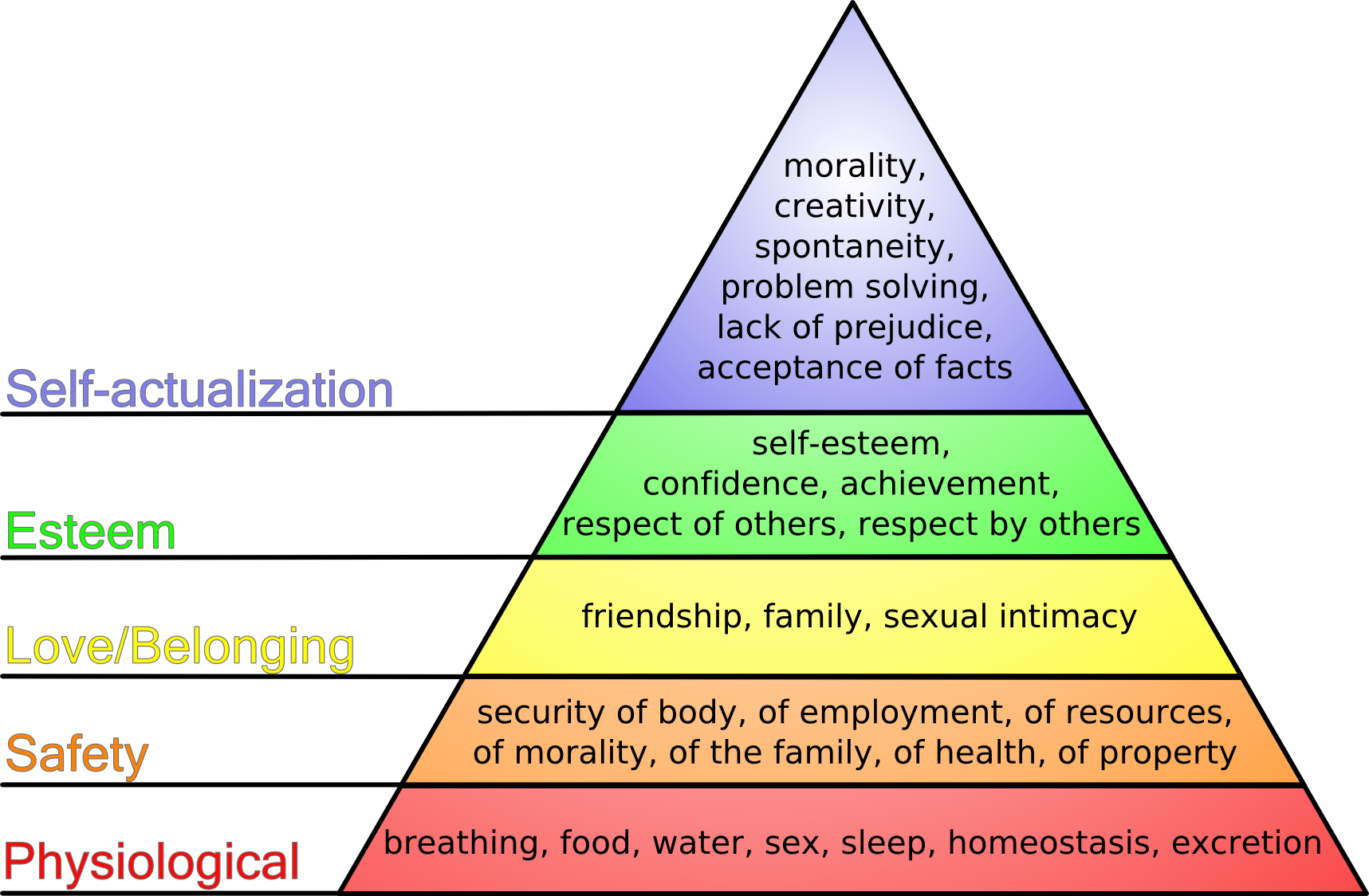 Chances are, sometime in your educational history, you learned about Maslow’s Hierarchy of Needs. I remember quite clearly learning about it for the first time in 7th grade. I don’t remember the class but I do remember the teacher, and most clearly I recall him more or less saying that none of us would ever achieve the coveted “self-actualization” at the top of the pyramid. That place was only reserved for the highest of high achievers, and according to Mr. Black, we were
 all doomed to be a bunch of mouth breathers unlikely to hit this mark.
Being an impressionable 13-year-old, I didn’t yet understand the idea of people projecting their insecurities onto others, and geez, I can’t imagine a junior high teacher feeling the slightest bit frustrated by their job or their students (sarcasm intentional). In my adult life, I feel like I really am touching that top part of the triangle at times. But I also know a lot of people who haven’t quite made it into the level below, of just having good self-esteem and confidence.
Reviewing the hierarchy again from my current perspective, I think it’s useful, but I’m not sure it’s everything. It mentions nothing of spirituality (though Cloninger’s Temperament and Character Inventory does take it another step further to include self-transcendence – the spiritual dimension), and it places somewhat high importance on being liked by others – as much, really, as being liked by yourself.
Nonetheless, reading through the list of characteristics of those who are self-actualized, there were a few that stood out to me as part of my own goals:
Comfortable acceptance of self, others, and nature: I’m learning to accept myself, and accept other people, though at times it’s not always comfortable. It’s a skill I’m growing.
Continued freshness of appreciation: These are simple things like enjoying a stunning sunset, or someone’s beautiful singing, but appreciating it as thought it was the first time you’ve experienced it. A spirit of gratitude gets me closer to this kind of experience.
Profound interpersonal relationships: I have deeper, richer friendships than ever before, and true appreciation for the good of humanity. Someday I hope to add a romantic love relationship that will be centered on deep bonds and true intimacy.
Peak experiences: This is described as feeling at one with the universe, strong and calm, with deep purpose. I have had some sincere moments like this, and I am grateful for them.
It turns out this belief that I’d never achieve self-actualization was only a self-limiting myth. I’m grateful to be dispelling it, for myself.
Healing the Child Inside
 Louise Hay posted an interesting article today about healing your “inner child” — in essence, examining your childhood wounds and soothing that child that still exists within you, even as you’re walking around with these wounds as an adult.
This is rather timely for me in a number of ways. Mostly, it’s because I had one of the most emotionally profound experiences last week, when I was able to very deeply and intimately get in touch with my own inner child, feeling the pain I experienced back then but able to process it with adult emotional intelligence. It’s difficult for me to describe to someone who has not done this kind of work, or who might not understand it. But it was very, very real.
As the result of a recent breakup, I’ve spent times swinging between anxiety and sadness/loneliness (with some peaceful moments in between). But after a while I developed a lot of scorn for those emotions, just wishing they would go away and I could heal and move on. I was, in essence, “yelling at myself” for feeling these unpleasant feelings. I couldn’t understand why it would seem like I would get to a place of healing, only to find myself emotionally knocked down days later.
Somehow, some way (I truly believe through God), I was able to understand that these feelings were actually stemming from a very child-like place. The more I got in touch with it, I saw that it was a very scared little girl, who was feeling hurt and sad and lonely. She wondered if anyone would ever love her. She was in a lot of pain.
More evaluation revealed that this was me, around age 4 or 5. Somehow I had gotten the feeling that there was something wrong with me, that nobody loved me. At that time I couldn’t grasp or understand it. But I remembered thinking very clearly … “maybe if I’m just very, very quiet, and really good, they’ll love me.” From this I came to believe that who I was on the inside was not acceptable to show on the outside, and that I couldn’t ask for help or show that I really wanted or needed something. These are problems that have plagued me for years.
I was at yoga that night and I imagined this little girl next to me, doing the poses with a joyous and childlike spirit – the way she wanted to be, but felt like she wasn’t allowed. I spoke to her with the love that I so wanted back then, and told her that she was precious and beautiful exactly how she is. That night, I cried the most anguished tears, but I was crying the tears of that child who wasn’t able to cry them back then, or didn’t even understand why she felt sad in the first place.
Now I’m much more in touch with this piece of myself, and in the future I’ll be able to identify it when those feelings come up for me again.
To live a fulfilled adult life, it’s worthwhile to discover your childhood wounds and work on the process of healing them. Don’t think that just because the years have passed, they aren’t haunting you still. Find that child, and love it well.
Profound Forgiveness
What if, even in the face of someone else causing you unspeakable harm and tragedy, you were able to forgive them immediately? If you kept the resentment from burrowing deep within you, haunting and anguishing you?
This is the story of Rais Bhuiyan. In the wake of 9/11, Bhuyian was the victim of a hate crime. A man named Mark Stroman was randomly targeting people he thought were of Muslim or Middle Eastern descent. Stroman killed two men in addition to wounding Bhuiyan. He was executed in July 2011.
I saw this article in my Facebook newsfeed today – I actually think NPR posted it erroneously, since it was a year and a half outdated – and I put aside the post I had already written. What makes this story remarkable is that Bhuiyan says he never hated Stroman in return. He actually worked to save him from death row. He used his faith to find the power to forgive.
I am deeply moved by the ability for someone to be so emotionally free and to move on with grace. Instead of seeking retaliation, he sought to give his attacker salvation.
It gives me much pause to consider the resentments to which I am clinging, the wrongs I’ve been unable to forgive. In reality, they’re only causing harm to me, not their targets. As the saying goes, resentment is like drinking poison in hopes that someone else will die. It only pollutes my own spirit but does nothing to change the past or heal the wounds.
How have you found forgiveness – for yourself and others?
Risks and Rewards
When I started this blog, I really didn’t have any idea of goals or expectations for it. To be honest, it felt like a complete inspiration from God to even do it in the first place … I’d been kicking around ideas for many months, and then this one  came to me, and I was compelled to get it going quickly. It was up within 24 hours of me getting the “epiphany.” And I have warehouses of ideas for posts.
All I thought was … I feel like I want to share this knowledge that I’ve found and this strength that I’m building. I think God wants me to put this out there. Every day I see a lot of other people who seem to be struggling with the same issues. Maybe if I can help just one of them, it would be worth it.
But then I also wonder if it’s arrogant or naïve or unrealistic to even believe I could do that. I don’t feel like I have any great gift or knowledge that no one else has, I just feel like I’ve found a way to tap into it, and to genuinely feel it. But what I’ve “learned” seems like it’s been within me for a long, long time.
But I worry … could being honest and vulnerable like this come back to haunt me? If I write about some of these things I encounter in personal relationships … would someone I care about get hurt by it? Will pieces of this insight about myself somehow be used against me later?
It’s risky and scary putting some of this out there. Even though I don’t feel like what I have here is salacious, or even good “gossip fodder,” one of the things I’ve struggled with is an ability to trust. I don’t completely trust that while I feel like I’m trying to do a good thing, or at least create a good outlet for myself, that somehow it won’t be someone’s ammunition against me one day.
At the same time, I’m working to develop an attitude of “this is who I am – take it or leave it.” And I really am getting stronger in that every day. I know I’m a good person (and for a long time, I wasn’t sure of that), but also one who’s willing to admit to imperfections, struggles, and difficulties. But along with that comes the ways I’m working to overcome them, to grow into my purpose here on earth.
And so while I’ve wondered if I should keep doing this … if this really is a good idea to put myself out there so much … the voice I hear within my heart says keep going. Keep going.
I don’t know where this is leading, or even if there is a “where.” But today, I will keep going.
Acceptance, Pt. 2 – Acceptance of Others
I believe I’ve heard a quote that goes something like “It’s only by accepting others that we can learn to accept ourselves.” For me, it needed to go the opposite way – I had to accept myself first before I could extend it to other people. However this is accomplished, though, it’s a key toward sanity and serenity in relations between yourself and the people around you.
To me, acceptance means viewing someone as-is, right as they are this minute. This means realizing that they aren’t going to change unless they want to, and that me wanting them to change isn’t going to create that “want” within them. So I need to put that “want” out of my mind entirely.
Acceptance does not equal liking someone. When you accept someone, it doesn’t mean you’ll become BFFs or turn a blind eye to past wounds and wrongs in your relationship. It also doesn’t mean putting yourself in the path of someone’s punishment or toxicity – you don’t have to accept unacceptable behavior, nor should you, but regardless, it’s important to accept the person behind it. This acceptance is more for you than the other person, because it will help clear the static from your mind and help keep your focus on yourself – the only person you really can change and control – vs. everyone else.
In the reverse, just because you love or like someone doesn’t mean you’re practicing acceptance with them. You might love your child/parent/sibling/spouse/best friend/significant other/cousin but not show acceptance toward them. “If only they lived somewhere else.” “If only they didn’t watch so much TV.” “If only they had made a different career choice.” “Why can’t they buy the outfit I picked out instead of the one they like?” “Why can’t they eat a healthier diet and get to the gym every now and then?”
Sure, you might have those questions and judgments in your mind, but where it gets dangerous is when you start communicating out those feelings, especially when there’s a dose of guilt and/or attempt at manipulation attached to it. “Yes, I know you like living in that city where you are … you always have been into doing what you want.” “I can’t believe you like that stupid show! Why do you keep watching it?” “Everyone’s going to laugh when you step into the party wearing that thing.”
Of course, some of those messages can be communicated in a gentle, loving way. But if you feel you might have sent these kinds of messages a time or two, ask yourself: What’s my motive behind it, and what am I feeling when I say it? If it feels like you’re trying to lash out, even in the slightest way, proceed with caution … or not at all.
Here are some common phrases that go behind or along with non-acceptance messages: “It’s just so stupid.” “I can’t believe you’d act so selfish/immature/dumb.” And the real zinger: “Why do you have to be that way?”
Think of how much richer your relationships could be, and how much more sane and serene you would feel, if you accepted the people around you and stopped wishing/hoping/praying they’d be different. In family and partner relationships, think of how much more loving your interactions could be if there was no longer the urge to give your opinions on “what’s wrong with them.”
But again, accepting someone doesn’t mean you’ll allow them to walk all over you, to cross your boundaries, to treat you in any manner that’s abusive. It doesn’t mean you’ll keep dating or stay friends or stay married. It means that you’ll realize that this person – their personality makeup, their decisions, their actions, their dreams and desires – are not yours to own, control, or change. And by practicing this, you’ll realize the same is true in reverse. Your life is yours to own and manage as you see fit, with your own best interests at heart – not those projected onto you by someone else.
How have you learned to accept other people?
 Young Spirit, Old Soul