
Humility: A Gift
When you hear the word “humility,” what do you think?
This is my definition: Humility is a state of egolessness. It is a recognition of yourself as equal to the rest of humankind – no better, no less. It is a willingness to admit to flaws and defects. It is an act of submitting to a Higher Power, of admitting that there is a non-human power that is greater than you. It means “to be humble.”
It’s important to make the distinction between “humility” and “humiliation.” In my mind, humiliation is shame, being disgraced, degradation. I believe that humility is an inner state of being, while humiliation is often a reaction to external factors.
I suppose one of the most interesting things I’ve found is that the more confident I am in myself, the more I believe in my own inherent worth, the easier it is for me to be humble. I don’t need the false trappings of the ego to artificially inflate my value. Seems counterintuitive, does it not? And yet, I’ve found my ego and pride to be very shallow pools indeed. Those are things built up (or deflated) by the clothes I’m wearing, the balance in my bank account, the car I drive – or the clothes someone else is wearing, the balance in someone else’s bank account, the car that someone else drives.
Self-confidence, though, runs deep. It allows me to see people around me as my equal. I don’t relate to them from a “one up” or “one down” perspective. We all become precious children of God, each with a special place in the universe with unique gifts to offer. Nobody has to be perfect. They don’t have to be anything other than themselves.
These are the gifts of humility – acceptance, confidence, a sense of serenity. I strive to make it more central to my character. I will be humble. I will be grateful.
Giving Up
 Sometimes, the hardest decision to make is when to give up.
In some cases, it’s crystal clear – like when the entrée you were making for a dinner party burns to a crisp and the guests are arriving in 15 minutes. Time to wave a dishtowel at the smoke alarm and grab your take-out menus.
But most things – especially important things – dwell in a shade of grey. Jobs, different kinds of relationships, activities or projects you’ve thrown your heart into … it’s often hard to know when to walk away or when to forge ahead.
I’ve had times when I’ve decided to leave something behind, only to have it come back to me in some manner. In those cases, I look at it as God telling me I still have things to learn from it … even if it still doesn’t work out in the end.
One bit of wisdom I heard about difficult decisions was to think of it like this: Does this situation leave you feeling drained, or can you still derive energy from it? It’s not always cut-and-dried, but something that constantly pulls you down is probably not a great situation for you.
So, as I face a few of my own hard choices, these are the questions and thoughts I’m keeping in mind:
- Is this situation barring me from meeting my goals and having the life that I want, or being the person I want to be? This is for long-range thinking … where do I want to be 5 or 10 years from now? How will this situation affect that?
- Does this decision affect other people, and in what ways? I’ve learned that you should never live your life with the goal of pleasing other people, or of living up to someone else’s agenda. But especially if you’re in a relationship, or if you have children, it’s important to consider a decision’s impact on them. It isn’t selfish to strive for the life of your dreams, but it becomes that way when it happens at someone else’s expense.
- How will I feel tomorrow? This is the “can you look yourself in the eye” question. What decision leaves you feeling proud of yourself?
- If there are certain aspects of this situation that don’t work for me right now, can they be changed – even if it’s just reframing my own attitude? This isn’t to say “put on a happy face” if things are legitimately bad. But especially if an alternative isn’t readily or easily available, sometimes the best you can do is to detach your emotions to the greatest degree possible, and look for happiness in other aspects of your life.
As I walk through these experiences, I also find frequent prayer and meditation are also helpful. If I do my best to turn problems over to my higher power, and genuinely ask for help with a willingness to receive it, I have found it will come to me … sometimes quickly, sometimes slowly. But it will come.
The God of Your Understanding
This past weekend, I was part of a discussion where everyone was asked to share their idea of God – the God of their understanding. It turned out to be an insightful and fascinating discussion. As I’ve said on here before, I don’t think of God (or the Higher Power, if you will) as a one-size-fits-all deity. In fact, I’ve even found in my own journey, my idea of God has evolved and changed and grown.
Since I started to feel that I was “OK with God” (in other words, not too messed up for him to love me), and that it was OK for me to really believe and trust in this higher power, there are some characteristics that have remained as constants:
1. This God is loving. Why would I put faith into something that’s scornful and punishing?
2. This God is stronger than me. I can surrender my problems, my pain, and ask for the burden to be lightened. It’s worked for me, many times.
3. This God has a plan for me that will be revealed if I really listen for it – and it’s greater than what I can come up with on my own. And it feels a heck of a lot better than trying to “fight the universe” or forcing decisions that just don’t work for me.
But, there have been some changes too. As I’ve gotten away from a formal church environment and found other places and ways to develop my relationship with God, the way I interpret God has changed too: I now see God less as an “outside entity” and more like something that’s a part of me, something I carry around all the time. I think this part of being mindful – I really try to avoid doing things that go against my spirit. Most of the time, I know when that’s happening. (And I’m far from perfect on this, but it’s cool – I try to get it right next time.)
I’m sure this idea of God will grow and change for me as time goes on. That’s OK – I’m growing and changing too.
Self-Actualization and Maslow’s Hierarchy of Needs
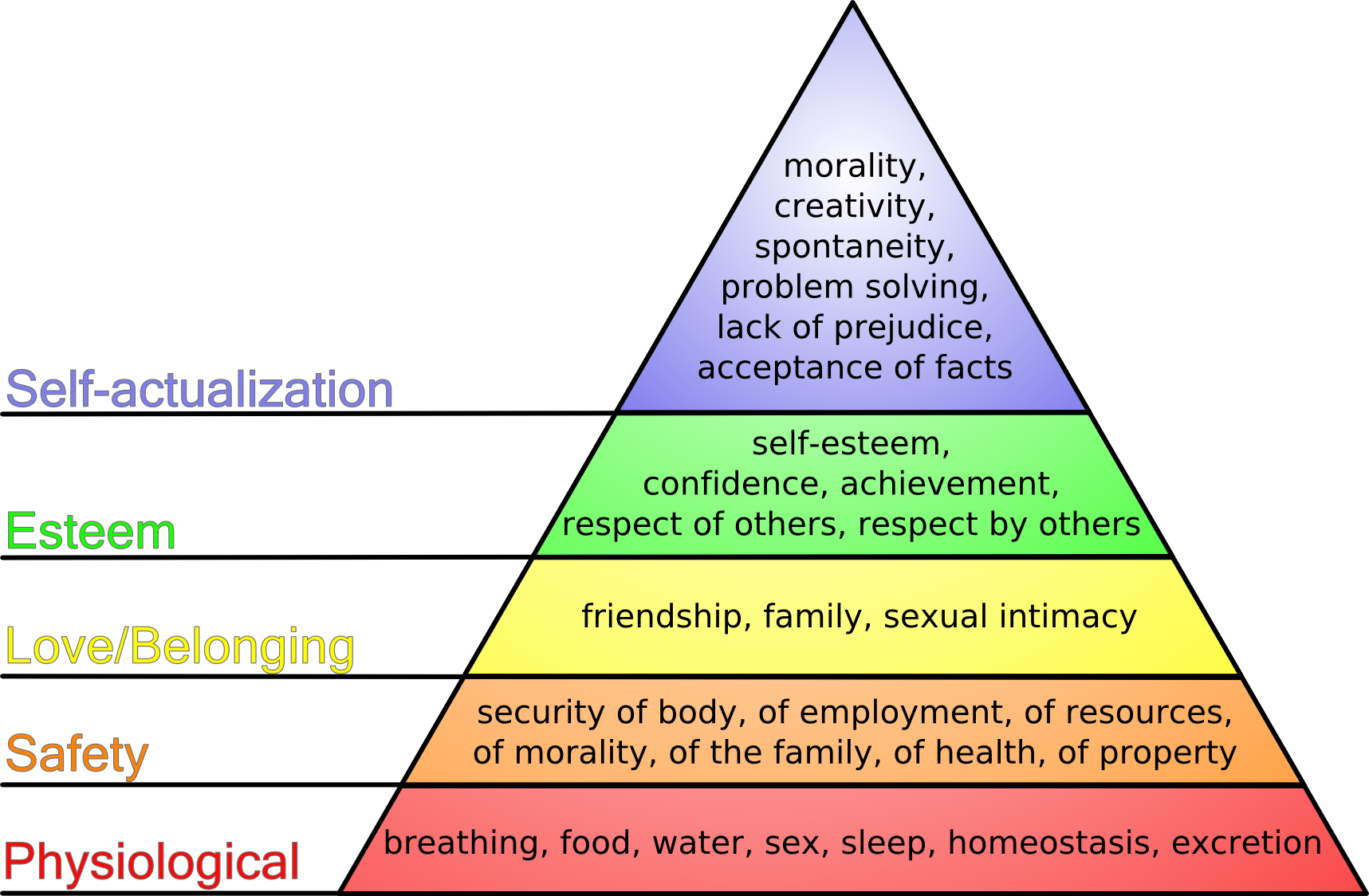 Chances are, sometime in your educational history, you learned about Maslow’s Hierarchy of Needs. I remember quite clearly learning about it for the first time in 7th grade. I don’t remember the class but I do remember the teacher, and most clearly I recall him more or less saying that none of us would ever achieve the coveted “self-actualization” at the top of the pyramid. That place was only reserved for the highest of high achievers, and according to Mr. Black, we were
 all doomed to be a bunch of mouth breathers unlikely to hit this mark.
Being an impressionable 13-year-old, I didn’t yet understand the idea of people projecting their insecurities onto others, and geez, I can’t imagine a junior high teacher feeling the slightest bit frustrated by their job or their students (sarcasm intentional). In my adult life, I feel like I really am touching that top part of the triangle at times. But I also know a lot of people who haven’t quite made it into the level below, of just having good self-esteem and confidence.
Reviewing the hierarchy again from my current perspective, I think it’s useful, but I’m not sure it’s everything. It mentions nothing of spirituality (though Cloninger’s Temperament and Character Inventory does take it another step further to include self-transcendence – the spiritual dimension), and it places somewhat high importance on being liked by others – as much, really, as being liked by yourself.
Nonetheless, reading through the list of characteristics of those who are self-actualized, there were a few that stood out to me as part of my own goals:
Comfortable acceptance of self, others, and nature: I’m learning to accept myself, and accept other people, though at times it’s not always comfortable. It’s a skill I’m growing.
Continued freshness of appreciation: These are simple things like enjoying a stunning sunset, or someone’s beautiful singing, but appreciating it as thought it was the first time you’ve experienced it. A spirit of gratitude gets me closer to this kind of experience.
Profound interpersonal relationships: I have deeper, richer friendships than ever before, and true appreciation for the good of humanity. Someday I hope to add a romantic love relationship that will be centered on deep bonds and true intimacy.
Peak experiences: This is described as feeling at one with the universe, strong and calm, with deep purpose. I have had some sincere moments like this, and I am grateful for them.
It turns out this belief that I’d never achieve self-actualization was only a self-limiting myth. I’m grateful to be dispelling it, for myself.
 Young Spirit, Old Soul